Skip to content
Calibration Certificate

Loading…

Measured error
Maximum allowed
Calibrated on

Why this matters

A real SNES feeds its cartridge a precise master clock, 21.477 MHz for NTSC and 21.281 MHz for PAL. Your Operator reproduces that clock programmatically, so a single unit reads games from any region. Cartridges with enhancement chips like the SA-1 (Super Mario RPG, Kirby Super Star) or SuperFX (Star Fox, Yoshi's Island) run their own processors off this clock and need its frequency to stay exact, or they desync from the rest of the system.

So we calibrate your Operator at the factory against atomic clocks aboard satellites, holding it within 75 parts per million of the correct frequency. Every unit gets its own calibration, using whichever satellites happen to be above our assembly line at that moment. That data normally ends on an internal engineering sheet. We thought it should end here.

This page is the record of yours, specific and unique to your device: which satellites were overhead at that exact moment, the frequency error we measured, and the correction written to your firmware.

Satellites used

Calibration sweep

We tried a range of PPM corrections; the one with the smallest residual was written to the device.

Technical record

Questions

Do I need to do anything?

No. Your Operator is calibrated at our factory before it ships. Plug it in and play, no setup, no steps on your end. This page is a record of the work we did, not a task list for you.

Is this a one-time thing?

Yes. We calibrate every Operator once at the factory, and it's designed to stay accurate for decades. If anything ever drifts in the very long run, the firmware supports remote recalibration through software tools, so you won't need to send your device anywhere.

Should the globe view update as I travel?

No. The globe shows the exact sky that was above us when we calibrated your Operator. It's a snapshot of a moment, not a live view. Open this page from London or San Francisco and you'll see the same scene, because it's tied to the moment, not your location. Your Operator doesn't know where you are either.

Can the unit get decalibrated?

Very slowly, like your wristwatch does. The quartz inside ages a tiny amount each year, and normal shipping or temperature changes don't do any real damage. Your Operator is built to stay accurate for decades on its own.

Can I calibrate it myself?

Yes, it shouldn't ever be necessary, however, there's two ways:

The practical path is a self-check we're building: insert one of your more demanding games and your Operator tries tiny adjustments until it runs cleanly. Really only useful 15+ years out, as the crystal slowly ages.

The rigorous path uses lab equipment, matching our factory setup. Overkill, expensive, and difficult to set up, unless you're into that sort of thing.

Your factory calibration is set to last decades. We'll also open source the code needed to run this calibration if Epilogue ceases to exist by then (we don't plan to).
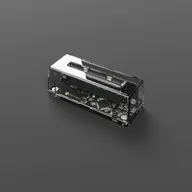
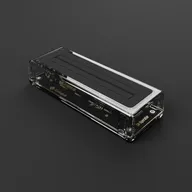
Measured error reflects the device's frequency offset at the moment of calibration, measured against a GPS-disciplined reference oscillator in our in-house metrology laboratory. The reference traces to UTC through the GPS broadcast signal; UTC is maintained by the BIPM from contributions by national metrology institutes including USNO (United States), NICT (Japan), PTB (Germany), and NPL (United Kingdom). This is an in-house calibration performed on every unit, not a one-time reference-lab certification.
The ± band shown with the measured error is the expanded uncertainty of the verification-step measurement, computed from the sample standard deviation using Student's t-distribution for the actual degrees of freedom, reported at 95% confidence in accordance with the JCGM 100 (GUM) convention. It reflects the device's short-term frequency stability at verification; the reference chain contributes an uncertainty orders of magnitude smaller and is absorbed into this band.
The 75 ppm target is Epilogue's internal engineering limit. The SNES cartridge interface has no published industry specification; the values used across the community are reverse-engineered from original hardware. The 75 ppm figure sits well inside the margin at which cartridge enhancement chips and timing remain reliable. Calibration holds within this limit across typical consumer operating conditions (0–40°C) for the expected service life of the device. Performance at extended industrial temperatures (−40 to +85°C) remains within spec but consumes a larger share of the budget due to quartz temperature coefficient. The onboard 25 MHz TCXO reference has an initial tolerance of ±10 ppm and a temperature stability of ±30 ppm across its rated range. Long-term aging is typically under 5 ppm per year.
Satellite positions are computed from two-line element sets (TLEs) captured and embedded at the time of factory calibration. The globe visualization reproduces the sky overhead at that moment; it is not a live view.
Cloud cover shown on the globe is decorative and does not represent actual meteorological conditions at the time or location of calibration. It is rendered from a generic reference texture and is not derived from, or intended to depict, the weather on any specific day.
Orbital elements courtesy of CelesTrak (celestrak.org) and the GLONASS Information and Analysis Center (glonass-iac.ru). Constellation operational status and slot assignments are drawn from the same public sources.
Epilogue is not affiliated with or endorsed by any operator of the satellite systems named on this page. GPS, GLONASS, Galileo, BeiDou, QZSS, NavIC, and the regional SBAS networks (EGNOS, WAAS, GAGAN, SDCM, MSAS) are government-owned systems; their names are used descriptively to identify the signal source used during calibration.
Super Nintendo, SNES, SA-1, Super FX, Super Mario RPG, Kirby Super Star, Star Fox, and Yoshi's Island are trademarks of their respective owners. Epilogue is not affiliated with, endorsed by, or sponsored by Nintendo.